
Eswatini: Liyana (2017)

The reason I’m favouring horror isn’t because I like being scared (although I freely admit that I do) but because extremes push us to show our real selves. Well, as much as narrative fiction can anyway.
Buying a film from every country isn’t interesting in itself – anyone can do that. What’s interesting is what those films can tell us about the world. My belief is that most people around the planet are very much the same – they don’t care who you sleep with, what you eat, who you pray to or what you wear, as long as they can get on with their own lives in peace. That’s my theory, anyway. I’m hoping that seeing a film from every country will demonstrate that, and so far it has done. The preference for horror is partly because it’s an engaging genre, partly because I think horror translates well even when subtitled, and partly because extremes reveal more about us than normal situations. And, frankly, because I just like horror.
Liyana, a film from Eswatini (although it was known as Swaziland at the time of release), is not a horror film. It’s not an animated film either, despite featuring animation. Nor is it a documentary, despite being a documentary. There’s an adventure in it too, but it’s not an adventure story. I don’t know how to classify it – but I do know that it’s magical.
Eswatini has the worst incidence of HIV in the world (25% of the country – at the time of Liyana’s release – were HIV positive). Those are disturbing numbers. (What the film can’t tell us is that the country has managed to successfully address this in the decade since, and infection rates are reducing more swiftly than in most other countries.)
Liyana is the heroine of a story told by the children of the Rock of Hope Children’s Home, an orphanage in Manzini, Eswatini. Their amateur storytelling is aided by a professional: South African children’s author Dr Gcina Mhlope.
The film itself works in multiple ways – it’s the story of the children in the orphanage; it concerns the impact of HIV on Eswatini; it’s a children’s folk/fairy tale about a fictitious child rescuing her lost twin brothers; it’s a film in which fiction is the medium for children to confront loss and their own personal tragedies. Which is why I mentioned horror earlier – this shows my hypothesis in action, although with fantasy used to explore the human condition, rather than horror. That said, some of the incidents faced by Liyana (her abusive, drunken father is not a pleasant character, although he is alarmingly credible because he’s created from the shared experiences of the children) verge on horror anyway, but then so do the experiences faced by the children. The father dies of AIDS. We don’t learn the individual details of each child (the film isn’t in any way intrusive), but I suspect that many fathers here have died of AIDS.
How the film can do all of this in only 77 minutes without becoming remotely preachy or too earnest - or even feel rushed - is thanks to the directors Aaron and Amanda Kopp; the film is structured beautifully, and they clearly spent enough time with the children (and Mhlope) that they fully gained their trust. At no point is that trust misplaced. The stories of the children are told without any hint of judgement, and without any moralising. The children are never allowed to be anything less than themselves. ‘Wise beyond their years’ is an easy comment to make, but these children are indeed wise, and they have accepted their pasts with astonishing grace and optimism; they look only to the future. We never see a great deal of the staff running the orphanage, and hear even less from them, but we do see the children and from them we can intuit the work the staff are doing. In many ways they’re the unsung heroes here, and rightly so, because this isn’t about them – it’s about the children.
The Kopps never lose focus of the multiple plates they’re spinning (even a section in which one of the children is taken to a clinic to be tested for HIV – which is genuinely harrowing to watch when the outcome seems so pre-determined – isn’t played for sympathy or used as a polemic) and the story of Liyana and her bravery is the backbone of the film.
Liyana herself is allowed a happy ending. As the film closes, we have no idea what the future holds for the children, but the film allows us enough optimism to hope that they have a future after all.
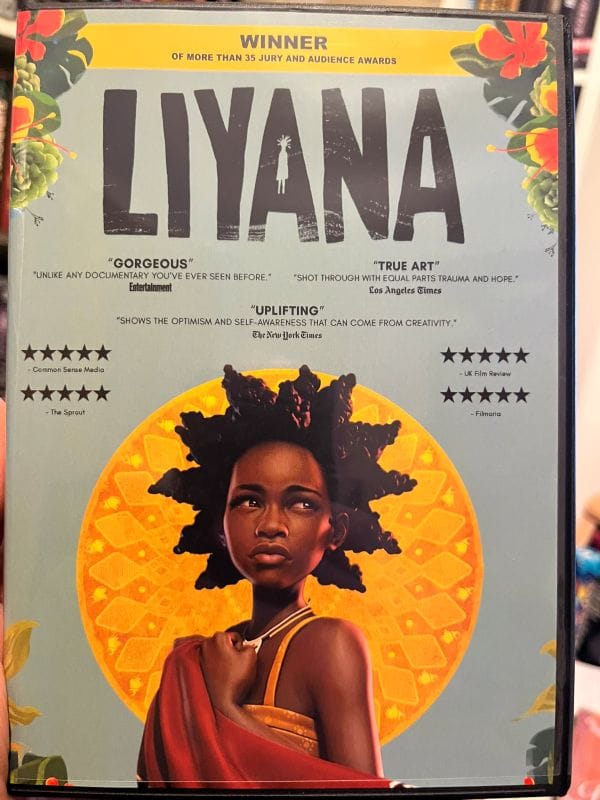
Disc: DVD (Region free, USA)
Source: eBay
Availability: Out of print but still widely available