
Iran: Fish & Cat (2013)

There are two films here. The first is an astonishing technical tour de force, a 135 minute film shot in a single take, complete with flashbacks. How you can manage flashbacks within an uninterrupted take is something I never thought possible, but it’s done here, and it works. We see several scenes play out repeatedly from different angles and from the point of view of different characters. It’s remarkable, and I cannot stress enough how impressive the technical achievement is.
I have no idea why it was necessary.
I get why you’d want to produce a film in one take – it’s a bravura act that shows what you can do. In the case of, say, a found footage horror film it’s also a way of guaranteeing complete audience immersion.
That’s not the case here. There is no immersion. Being thrown out of the film every fifteen minutes by the need to exclaim “oh, that’s clever” is not immersive. It’s the opposite of immersive. It’s distracting. Particularly when there’s no need at all for it.
There is nothing in the plot of this that justifies the direction. At one point I was expecting a Priestleyesque exploration of time. It doesn’t happen. The flashbacks are just that – flashbacks. They’re not even there to expand upon plot points (because there are no plot points) or to reveal hidden secrets the audience missed the first time around; they’re there because it shouldn’t be possible to do flashbacks in one take, and the director wanted to prove that he could. When the sole revelation from a flashback is “oh, he said hello from over there because he happened to be walking that way” it’s not exactly a reveal of shocking awesomeness. It doesn’t help that what has been perceived by some to be some kind of time-warping study of reality really isn’t – the flashbacks are there to show off, nothing more. They’re technically astonishing, but they add nothing to the narrative.
I did wonder if the dialogue – which initially seemed to be verging on Stoppard – was going to be some kind of post-modern deconstruction of fate, intention and existentialism. Nope. It’s just people talking about stuff. Key phrases are thrown out not because they’re significant, but because they’re there for you to remember when you hear them again from a different angle. It’s stylistically clever, but narratively it’s meaningless.
If the opening text hadn’t told us that a restaurant was once closed down because it was using human flesh, you’d have no idea what this film was about, because it’s not about anything. Things happen for no reason. Elements are thrown at the viewer in an attempt to arouse curiosity. They’re never resolved. One character is accompanied by an angel that only she can see. (She says he’s a messenger but given that he never actually passes on any messages I don’t really trust her judgement.) There is no reason for the angel to be there. I was expecting some kind of denouement in which all the loose ends are drawn together in a satisfying whole. It never comes. The character who has apparently some form of second sight? One scene only. The guy with the plaster on his head? Nope, unresolved. The twins who would appear to have been conjoined but separated, wandering around carrying live ducks? I have no idea why.
And so the film goes on, and on. And on. Introducing elements which lead nowhere. It’s all very well being able to do something technically impressive, but if there’s no good reason for it it’s just an impressive trick. There’s a reason magicians never reveal how it’s done – because when you know, there’s nothing there at all. That’s this film in a nutshell.
The most annoying part is that the narrative is clearly only structured this way so that the film can be made. There’s no necessity for this to be one take. The plot (and it’s more loose vignettes than a plot) is designed purely to facilitate the technical side. This isn’t real. This isn’t credible. The characters aren’t given depth because they’re only there to service the plot. And once you’ve seen the clever way the film is constructed, there’s nothing more to see. The Emperor is naked. The magician’s sleeves are empty.
I should have made an exception and allowed Under the Shadow instead.
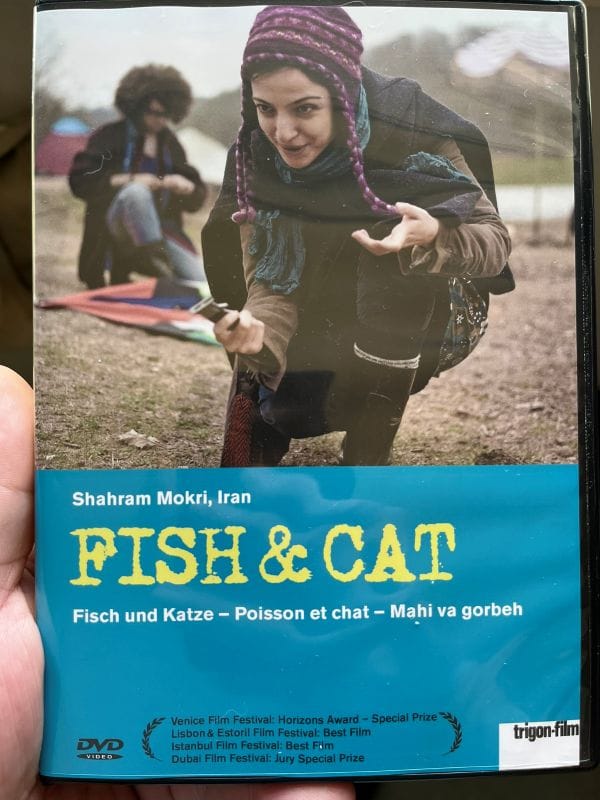
Disc: DVD (Region free (PAL), Switzerland)
Source: Purchased direct from trigon-film
Availability: Still in print (an American Blu-ray is also available from Deaf Crocodile films)