
Equatorial Guinea: Where The Road Runs Out (2014)

I should probably stop opening these pieces with “Now, I don’t know much about…” because it’s starting to make me sound unusually parochial, but in the case of Equatorial Guinea all I know is that it’s probably on the equator (and that’s not actual knowledge – it’s a blatant guess).
What I do know now is that although the country is rich (it has oil) the wealth has not been distributed fairly – it’s being hoarded by a small number of people. Those people are living a life of opulence; the remaining populace are not. So it’s very much like the rest of the world, then, with added tropical rainforest.
Copilot informs me that Equatorial Guinea has no film industry. ChatGPT tells me there is one, but it’s nascent (lovely word). Gemini says there’s a tiny film industry with no releases on DVD.
Basically, all three were telling me that I’d never be able to find a film from Equatorial Guinea, so when I pointed out to all three that I had tracked down Where the Road Runs Out they all gave different responses. Copilot’s response was that the film doesn’t count according to my original rules because it’s not a very Equatorial Guinean production (the Netherlands and South Africa provided most of the funding). ChatGPT pointed out that although it was filmed in Equatorial Guinea it wasn’t particularly about Equatorial Guinea, so it didn’t meet a different rule. Gemini apologised and said that I was right.
And I think I am right. I think it counts. I accept that the director is South African, the funding is mostly Dutch and the leading actor is from the Ivory Coast, but dammit the film’s got some Equatorial Guinean funding behind it, is filmed in Equatorial Guinea and is a film about a man going to live in Equatorial Guinea. How much more Equatorial does it need to be for the Guineans to count?
(Later on, there will be countries where this becomes a very distinct problem, at least if what Copilot keeps repeatedly warning me is accurate. It’s not the case here - I’ve been making light of it, but I genuinely think this is an acceptable title for the country, not awkward fudging – when it comes to some other African or Middle Eastern (or even Central European microstates) then what constitutes being “from” somewhere is definitely going to be something I need to examine. But not this time.)
I mentioned the leading man being from the Ivory Coast, and it’s notable because I actually know who Isaach de Bankolé is (appearing in 24, Casino Royale and the Black Panther films makes it quite hard to forget him) and also his co-star Juliet Landau (an outstanding actress I’ve always considered to be highly under-rated). Given that I’m watching films from countries I’ve never previously encountered, it’s unusual to see actors I know. Obviously that’s because in both cases they’ve been imported; despite that, amusingly, neither of them is using their own accent - de Bankolé is playing someone who left Africa as a child, Landau is playing an Englishwoman. (Landau also doesn’t just re-use the English accent she perfected for Buffy and Angel – she gives Corina a slightly more plain, middle-class voice than Drusilla had, and it’s the kind of detail that many actors don’t have the time or inclination to master. Like I said; she’s under-rated.)
The story itself is slight, to put it mildly; it’s a film in which a man who has lost his way in life goes to the middle of nowhere and rediscovers not only his roots, but also his purpose in life. This is not a radical premise. This is very much the opposite of a radical premise, and the most remarkable thing is how little is done with it. George does not have adventures. George does not uncover a local crime ring and save the village. George doesn’t take on the nefarious land-developer and save the residents of a doomed town. George paints a building and does some research. For 90 minutes. Yes, there’s a school nearby run by Juliet Landau. Yes, one of the children is adorable, wise beyond his years and also disabled. No, the disabled child doesn’t get sick. Nothing, in fact, happens. At all.
Yet it somehow works.
The characters are developed just enough that they never become caricatures, so we see them as real people, and the majority of that is done by the actors; Sizo Motsoko gives a particularly good turn as Jimmy, preventing the boy from becoming simply the cute, disabled kid and imbuing him with credible depth.
The location too helps – Equatorial Guinea looks verdant, to put it mildly. If the film was intended as a calling card for the country it does the trick. It looks lovely. But it could be anywhere (ChatGPT was right on that point – this may be set and filmed there, but this could be any rural community on Earth. We learn absolutely nothing about Equatorial Guinea other than that parts of it are undeveloped but do have very healthy vegetation).
Yet, as I say, it works. It holds attention for an hour and a half. It’s actually charming. Ordinarily that alone wouldn’t count for much, but after African jazz beat-poets, Romeo and Juliet in the South Seas and cinematic carnage this was a breath of fresh air.
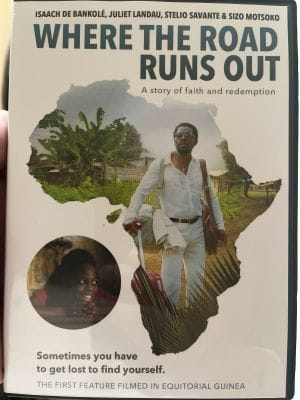
Disc: DVD (Region 1, USA)
Source: eBay
Availability: Out of print, but still widely available