Chad: Daratt (2006)

In case I’ve not already made it clear, I should explain what I’m looking for in a film. I want to be entertained, yes, but I also want to be treated as an intelligent adult: I don’t want to be given easy answers or told how to feel; I want to be allowed to think. I want to be given all of the necessary information and then allowed to come to my own conclusions.
Daratt, from Chad, is an outstanding example of this. The country has been through nearly four decades of civil war and those years have taken their toll. The groups on all sides have been fighting and the majority of the populace have been caught in the middle. It’s been long, bloody and violent. And as the fighting has drawn to a close, the country has faced that most awkward of questions: how do you move on? Is moving on even a possibility?
Sixteen-year-old Atim’s father was a victim of the violence, and when his grandfather hears on the radio that an amnesty is going to be given to people who committed acts of violence during the war, he is incensed: he wants his son’s killer brought to justice. He gives Atim a gun, tells him the city where the man is from and then sends Atim on his way to bring the justice the government refuses to enforce.
Atim, a pleasant if taciturn lad from the sticks, makes his way to the city to track down the former warlord who has since left the military, found God, married and opened a bakery. He is looking for an apprentice…
The set up itself is in no way surprising – it’s everything else that is.
At no point do you hear any of the following words: redemption, atonement, grief, regret, vengeance, revenge, retribution, punishment or responsibility. The film is far more layered and nuanced than that. Of course all of those themes are present, but they’re unspoken. The relationship that develops between Atim and Nassara (a stunning performance by Youssouf Djaoro who absolutely refuses to make the man likeable in any way at all, which instead humanises him and makes him real) is far more interesting than that, and far more ambiguous. We never know what Atim is thinking because he is mostly silent, barely able to express himself in words (perhaps even he doesn’t know what he is thinking, and Ali Barkai’s portrayal of the conflicted youth is the acting of someone with decades more experience than the teenager should possess). We also never hear what Nassara is thinking either because he never says – although everything is shown in his face. Djaoro really is breath-takingly good.
Writer/director Mahamat-Saleh Haroun gives no easy answers because there are no easy answers – it’s left to the viewer to decide what should be done, a stance that is made clear throughout the film: the camera holds on scenes for far longer than is normal, letting events play out at a pace far slower than the viewer is used to.
In less confident hands the tone could feel uncertain or even tedious, but here it plays into the ambiguity and gives the story chance to breathe. Although never rushed the sequences don’t become dull because although nothing is said, so much is shown; the audience are never unsure because it’s all there in the performances. The story and the people telling it are given the space to do so, through their physicality rather than their words. Even Atim’s hesitance is explicitly understood despite the reasons for it remaining unsaid. And because there can be no easy answers in a situation as complex as this (we’re effectively looking at the whole of Chad as a microcosm represented by these characters), the climax of the film, in which events come to a surprising conclusion, feels both perfectly resolved and also left perfectly open.
Daratt is an absolutely outstanding film, a rare one that is made by adults and for adults, and one that is well worth anyone’s time.
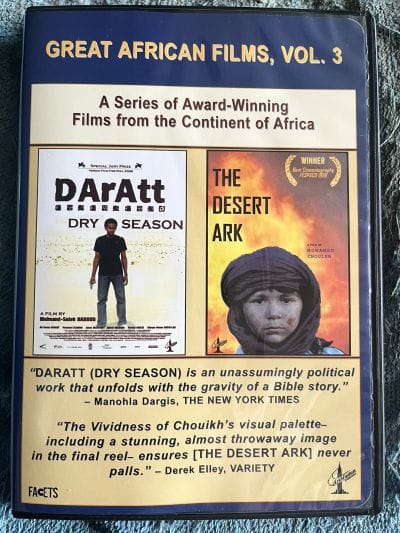
Disc: DVD (Region 1, USA)
Source: eBay
Availability: Currently available; you can buy direct here