Portugal: The Forest of the Lost Souls (2017)

My tolerance for art house horror is probably different to that of most people. It’s not that I’m a pretentious pseudo-intellectual who relishes obscure cinema (although I freely admit that I probably am), it’s that I like to view films as their own entities. I don’t care if a movie is mainstream or art house or somewhere in between: I just want honesty. A film which maintains its own premise succeeds. A film that doesn’t fails. It’s that simple. A director can work independently or within the studio system and produce vastly different films, but as long as each film works on its own terms then that film succeeds. David Cronenberg, for instance, can make a disturbing low-budget horror like Shivers, a studio film like The Fly and an astonishingly unusual film like Videodrome, none of which are in any way similar to each other, and each succeeds because it remains true to the world it creates.
When people talk about art house horror they usually refer to films with heightened levels of reality, or films in which the very events being depicted can be seen as metaphorical rather than literal. The Babadook, for instance, counts as art house horror because the titular entity is the physical manifestation of grief. It (either part) is mainstream horror because it’s made by a big studio for wide audience consumption.
Some people prefer their films to be literal and therefore reject art house horror. Some people prefer their films to be metaphorical and therefore reject mainstream cinema. Neither approach is wrong, it only becomes so when they reject something and decry it simply because they don’t like it. You can not like something without actually disliking it. Just because you don’t like, say, Skinamarink, doesn’t mean you think it’s terrible, simply that it’s not for you. (Whereas something like Sharknado is legitimately terrible for very different reasons – but that doesn’t mean you might not find it fun.)
Portugal’s The Forest of the Lost Souls is a case of this. It’s in black and white. It’s short. It’s weird. Not everyone is going to like it. Having now seen it, I’m not entirely sure if I liked it or not myself, but I certainly appreciated it. It’s doing a hell of a lot of work with extremely limited resources, which is really interesting. Most films do the work and show you the results. Not here. Much of the film is left entirely up to the audience to interpret and very little is spelled out. One could make multiple different readings of the film, and as I have too many other films to watch I didn’t listen to the commentary to hear what the director said – if anything – as to what the correct reading should be (if such a thing is even possible).
It's hard to discuss the plot without spoiling this in any way (and the paragraph after this is probably one you want to skip if you intend to watch the film), but basically a man goes into a forest in order to kill himself. There he meets a mysterious girl who claims to be there for the same reason. What happens next is startling and initially inexplicable.
For myself, I took the lead character (Carolina) to be the physical manifestation of the impact suicide has on those who live. Other readings are available. Whatever the intention, the film is rich with possibility, and uses its brief running time (not even 75 minutes) to present a visually stunning series of increasingly unexpected scenes, while maintaining an unusually oneiric atmosphere throughout. Suicide is rarely a subject for cinema, in the sense that it's examined in depth. We sometimes see the impact on others, more often than not it's an heroic act of self-sacrifice designed to tie up loose threads. Here, it's the entire subject of the film, and the ambiguity of the film's intentions work very much in its favour.
I can see why some might not approve, but I found it unusual, highly memorable, and strangely moving.
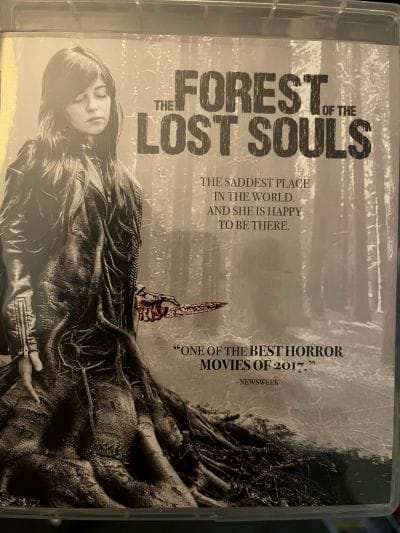
Disc: Blu-ray (Region A, USA)
Source: eBay
Availability: Still widely available; Region 2 editions also exist (DVD and Blu-ray), but not in the UK, it seems.