Switzerland: Sennentuntschi (2010)

I said a few posts back that I was going to focus on horror because I believe that horror will be the genre with greatest ease of access. I stand by that. This started out as a desire simply to see if it was possible to collect one film from every country. But I still have to be able to watch the films! 200 documentaries about making local cheeses are not something I would find particularly interesting. (Okay, I now admit that I might actually find the idea of cheeses of the world secretly appealing, but more the notion of tasting them than watching them being made.)
There are countries I know very little about. That’s not deliberate insularity – I’m a long, long way away from Eswatini, for instance. It’s not a big country (it’s a great answer for Pointless, though). It’s not surprising that I’m barely aware of it. So a film which doesn’t offer me any new insights into the country isn’t going to offer much to me in the way of watchability. That’s why I’m aiming – ideally – for horror films from each country. Horror itself is primal, and it’s therefore going to translate well, no matter where it’s from. That’s my thinking; it might be wrong. I need to see the films to find out. Obviously a generic horror film (a slasher, say) isn’t going to tell me much, other than that masked men with knives are scary, so I’m trying for folk horror. As subgenres go it’s one of the most varied, and it’s the one that will give the clearest view of a country and its inhabitants as possible. Or so my theory goes. (I’m well aware that for some countries a horror film won’t be possible. For those, I’ll take what I can get and hope that the film itself is at least entertaining.)
Switzerland’s Sennentuntschi (2010) is my first test case. (Local Swiss legend – three lonely farmers build a woman out of sticks. She comes to life. They take advantage of her. She kills them.)
I could not be happier. I watched this in a constant state of surprise. I went in as blind as possible and I’m so glad I did. If you don’t want spoilers, jump to the final paragraph of this entry because I can’t talk about this without spoiling it.
This is a good decade ahead of its time. This isn’t just folk horror, this is social commentary, to an unprecedented degree. This is #MeToo ten years early. The folklore (men make woman; men abuse her) is cautionary enough, but the film takes that idea and runs with it. This isn’t about nature made flesh, this is a film about men and their mistreatment of women. As a result of which it hits hard. The film also manages the very, very neat trick of playing with the narrative (most of this is told in flashback, but you’re never quite sure if the story is being told at several time periods consecutively, and the ambiguity is deliberate). There’s a genuinely shocking twist – well, a series of them – at the end, which have caused some viewers to complain about a convoluted plot (I was so blown away by the ending that I checked some IMDb reviews to see how common my reaction was), but everything makes sense and is presented fairly to the viewer. Visually the film swiftly establishes a Burtonesque fairy-tale atmosphere, which makes it even more jarring when some truly horrific things happen, and the backstory of the titular character is both shocking and tragic enough that it is guaranteed to stay with the viewer for some time.
I have no idea how well received the film was in its native Switzerland. I do know that I thoroughly enjoyed and it and would recommend it to anyone. It’s not “nice” by any means, but it’s strong, it’s definitely folk horror, and it travels well.
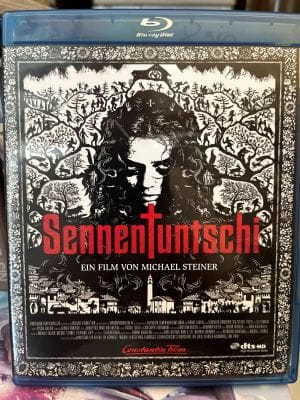
Disc: Blu-ray (Region B, Germany)
Source: Amazon marketplace
Availability: Still widely available; also on DVD in Europe and the USA